


Nepenthes lowii
Nepenthes lowii
Couldn't load pickup availability


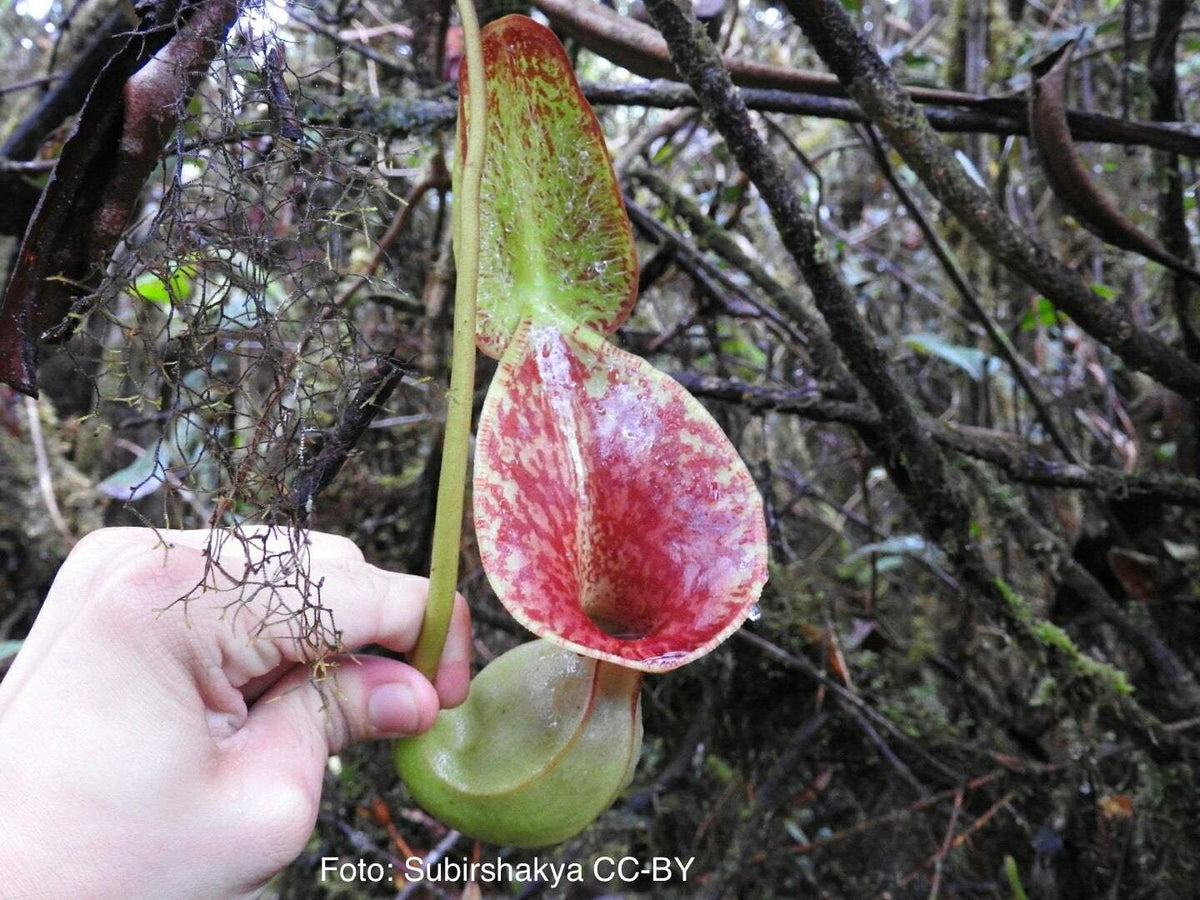
Highland pitcher plant from Borneo with funnel-shaped upper pitchers that collect treeshrew droppings
Nepenthes lowii is a tropical pitcher plant endemic to Borneo, named after Hugh Low who discovered it on Mount Kinabalu. The species is considered one of the most distinctive in the entire genus and is a classic highland species.

The plant is a climber, and the stem can reach over 10 meters in length. It forms two completely different types of pitchers. The lower pitchers are quite small, at most about 10 centimeters, usually red-green with a striped peristome and bristly hairs on the underside of the lid.
The upper pitchers are significantly larger, up to 28 centimeters high and 10 centimeters wide. They have a swollen lower part, a sharply constricted waist, and then a wide, open mouth with a lid that is held away from the pitcher. The color is usually green with a blood-red interior, and the pitchers are very rigid, almost woody. They retain their shape better than any other species even after they have dried.
What is truly unusual is how the species obtains its nutrients. N. lowii catches very few insects compared to other pitcher plants. Instead, the upper pitchers secrete a sweet, white substance on the lid. This attracts mountain treeshrews, which eat it while sitting on the pitcher, and their droppings fall into the pitcher. A 2009 study showed that mature plants obtained between 57 and 100 percent of the nitrogen in their leaves from treeshrew droppings.
Botanical description
The species grows at an altitude of 1,650 to 2,600 meters in nutrient-poor soil in the upper montane zone, both on the ground and epiphytically. The typical environment is moss forest or low, stunted vegetation along mountain ridges, often in a thick layer of sphagnum moss over limestone, granite, sandstone, or ultramafic bedrock.
Care
N. lowii grows very slowly until it reaches a diameter of about 25 centimeters, after which its growth accelerates. It often produces a few intermediate pitchers before the true upper pitchers appear. Even large plants form relatively few roots compared to most other pitcher plants. Under the right highland conditions, it is a stable and reliable plant.
Use a substrate of sphagnum, perlite, and preferably orchid bark in a 2:1:1 ratio. Keep it moist but not wet, and preferably water with distilled or rainwater. Provide bright, filtered light.
Like its habitat, the species prefers varying temperatures: about 19 to 27 degrees during the day and 9 to 17 degrees at night, but never below 12 degrees. The humidity should be around 70 percent during the day and preferably over 90 percent at night, which makes terrariums or greenhouses the best location.
Fertilize in the pitchers with diluted liquid orchid fertilizer approximately every two weeks, never in the substrate.
Shipping Policy
Shipping Policy
When buying live plants, transport can sometimes affect the condition of the plant. We strive to ensure that all plants arrive in good health, but minor shipping damage, such as a torn leaf or bent stem, is sometimes unavoidable. Read more about our policy here.



Join the customer club
Earn points on purchases and through special actions. Spend your points on rewards including gift products & discounts
Learn more about your plants!
View all-

How to repot houseplants - Step by step
Repotting houseplants is the key to keeping your indoor plants healthy and happy. It's all about the right soil, the right size pot and a little patience. In our guide...
How to repot houseplants - Step by step
Repotting houseplants is the key to keeping your indoor plants healthy and happy. It's all about the right soil, the right size pot and a little patience. In our guide...
-
Indoor Climbing Plants | Complete Guide to Clim...
Indoor climbing plants bring life and movement to your home. They can hang freely from hanging baskets or climb up trellises. These green plants quickly transform windows and corners into...
Indoor Climbing Plants | Complete Guide to Clim...
Indoor climbing plants bring life and movement to your home. They can hang freely from hanging baskets or climb up trellises. These green plants quickly transform windows and corners into...
-

Propagate your Houseplants | Tips from the Expert
Is there anything more satisfying than watching a new plant grow from a cutting you made yourself? Plant propagation involves creating new plants from parts of your existing plants. It's...
Propagate your Houseplants | Tips from the Expert
Is there anything more satisfying than watching a new plant grow from a cutting you made yourself? Plant propagation involves creating new plants from parts of your existing plants. It's...

