
Beginner's Guide to Plant Lighting: How to Choose and Use Plant Lights
Having a home with little or no natural light is a common challenge when growing houseplants. Fortunately, grow lights make it possible to create a green plant collection all year round! Most plants need at least some light to survive, light is simply food for plants.

In our store we use a lot of plant lighting to keep the plants healthy and happy. We use both special plant lights and 'regular' lights.
Grow lights are specially designed to act as a replacement for natural sunlight, enabling photosynthesis and thus the growth of healthy and beautiful leaves on your green plants.
But can you use a regular lamp as a grow light?
Yes, you can actually use regular lights as plant lights, but there are important things to consider.
If you choose to use CFLs or regular LED lights (which are not grow lights), they should be in the 5000-6500K spectrum, which is a very cool light that almost looks blue. This is the spectrum that green plants need for photosynthesis.
The problem with regular lights is that they are made for humans, which means they often have low intensity in the spectrum that plants need. We humans only use light to see, not to absorb nutrients like plants do.
What is the difference between a grow light and a regular light?
Common lamps:
- Designed for human vision
- Often gives yellow, warm light
- Ineffective for plant growth
- More electricity consumption for the same plant benefit
Plant lamps:
- Specially designed for photosynthesis
- Covers the most important parts of the light spectrum
- Less energy consumption thanks to directed light
- Less waste light = more environmentally friendly
Plant lighting is often more energy efficient because it directs the light where the plants really need it, instead of spreading it everywhere. This means less electricity consumption and less environmental impact!
Which lights are best for plants?
There are three main types of indoor plant lighting You can choose between (apart from HPS which gets a bit strong):
1. LED plant lighting: The best choice

LED plant lighting is definitely the best option for most plant lovers. LED lights for plants are:
- The most energy efficient
- Provides lowest heat generation
- Provides full spectrum light, perfectly adapted for your plants.
- Many LED grow lights also offer the ability to switch between different light colors and adjust the brightness.
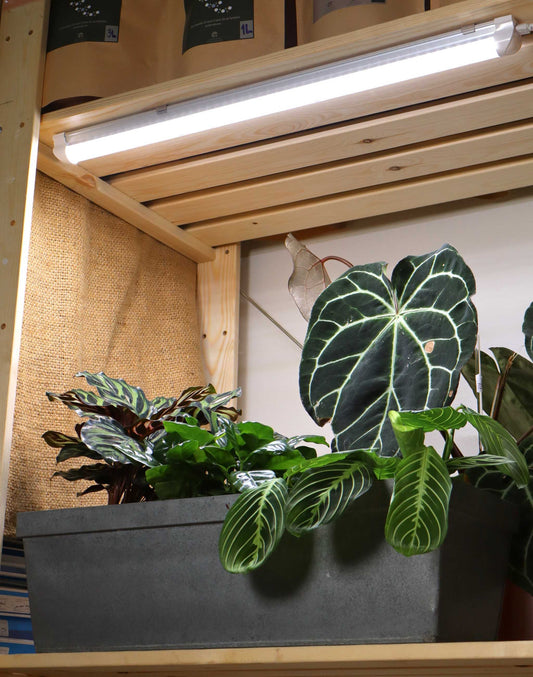
Our plant lighting mostly consists of oblong fixtures , like the one in the picture above, which provides a super good spread of light for growing on shelves.
You can buy the lamps here!
2. Fluorescent tubes (CFL): For the handy
Fluorescent tubes are well known because they provide a wide spectrum of light and develop little heat, but still more than LED bulbs. They are more expensive than incandescent bulbs but more energy efficient than them.
However, all fluorescent tubes contain mercury, which is harmless inside, but if the tube breaks there is a risk that the substance will contaminate the environment. Mercury is a strong poison that causes damage to the central nervous system and kidneys.
Since we are quite clumsy, which we (hopefully) are not alone in, we usually advise against using these lamps.
3. Incandescent bulbs: Cheapest but worst

Incandescent bulbs are the cheapest but also the least efficient with high heat generation. Not recommended for serious plant cultivation.
LED Grow Lights vs LED Plant Lighting: What to Choose?
Plant lights (only the light)
Cheap plant lighting in the form of individual LED bulbs allows you to replace your regular bulbs with plant bulbs in existing fixtures. These bulbs can be with, for example, E27 or E14 fittings.
This option is the cheapest but has the disadvantage that they need a proper stand to be mounted on. In our store we have these LED lights in the ceiling as spotlights. However, the light is quite difficult to get close to the plants that way.

Complete plant lighting systems
Stylish plant lighting in the form of complete systems is more expensive but gives the best results. Because they are designed specifically for plants, they provide full spectrum and have a more even light distribution. These lights are also much easier to mount on benches or shelves.

When should you start using grow lights?
You should consider plant lighting when your plants are not getting enough natural light. This is noticeable when the leaves become pale, the plant loses leaves and stretches towards the light. The stems then become very weak and elongated, which does not look as compact and nice as most people want from their plants. Some examples can be spaces such as bathrooms, hallways, basements or other dark corners.
Best time to start: Preferably before problems arise! Indoor plant lighting works great as a preventative measure.
What kind of light do green plants need?
For plants grown for their beautiful leaves (not flowers), blue light is most important. Blue light helps the plants produce chlorophyll and grow healthier.
That's why regular lights should have a 5000-6500K spectrum, it provides the blue light that green plants love.
How to place and use plant lights
Investment
Ideally, a small grow light or larger grow light is placed above the plants as it mimics sunlight best. The distance depends on the type:
- Incandescent bulbs: at least 60 cm distance
- Fluorescent lamps: 30 cm distance
- LED plant lighting : as close as 15 cm. The closer, the stronger the light. If the lamp is weak, it needs to be very close to the plant, while a stronger one can be several meters away.
Time and timer
Most green plants need 12-14 hours of light per day. Remember that at least 8 hours of darkness is also important, this is when the plant processes the energy from the light.
Many modern LED grow light systems have built-in timers that automatically turn the light on and off. Alternatively, you can buy a so-called 'switch timer', on which you set the desired time for the grow light to be on.
Why choose LED plant lighting?
LED plant lighting is simply the smartest investment for your green plants:
Energy efficient - Lower electricity costs
Environmentally friendly - Less energy waste
Long-lasting - Lasts for years
Low heat - Risk of burns is minimized
Full Spectrum - Gives plants exactly what they need
Tips for success with indoor plant lighting
- Start with an LED plant light for best results
- Check regularly that nothing is burning.
- Adjust the height as the plants grow
- Use timer for consistent light cycle
- Combine with natural light when available
Find your perfect plant lighting
Whether you're looking for a grow light for a single plant or want to buy grow lights for an entire collection, the right light makes all the difference for your green friends.
Ready to give your plants the light they deserve? Explore our range of energy-efficient LED grow lights and find the perfect solution for your home!