


Begonia solimutata
Begonia solimutata
Couldn't load pickup availability


Brazilian begonia with black-green bumpy leaves, creeping growth habit perfect for terrariums
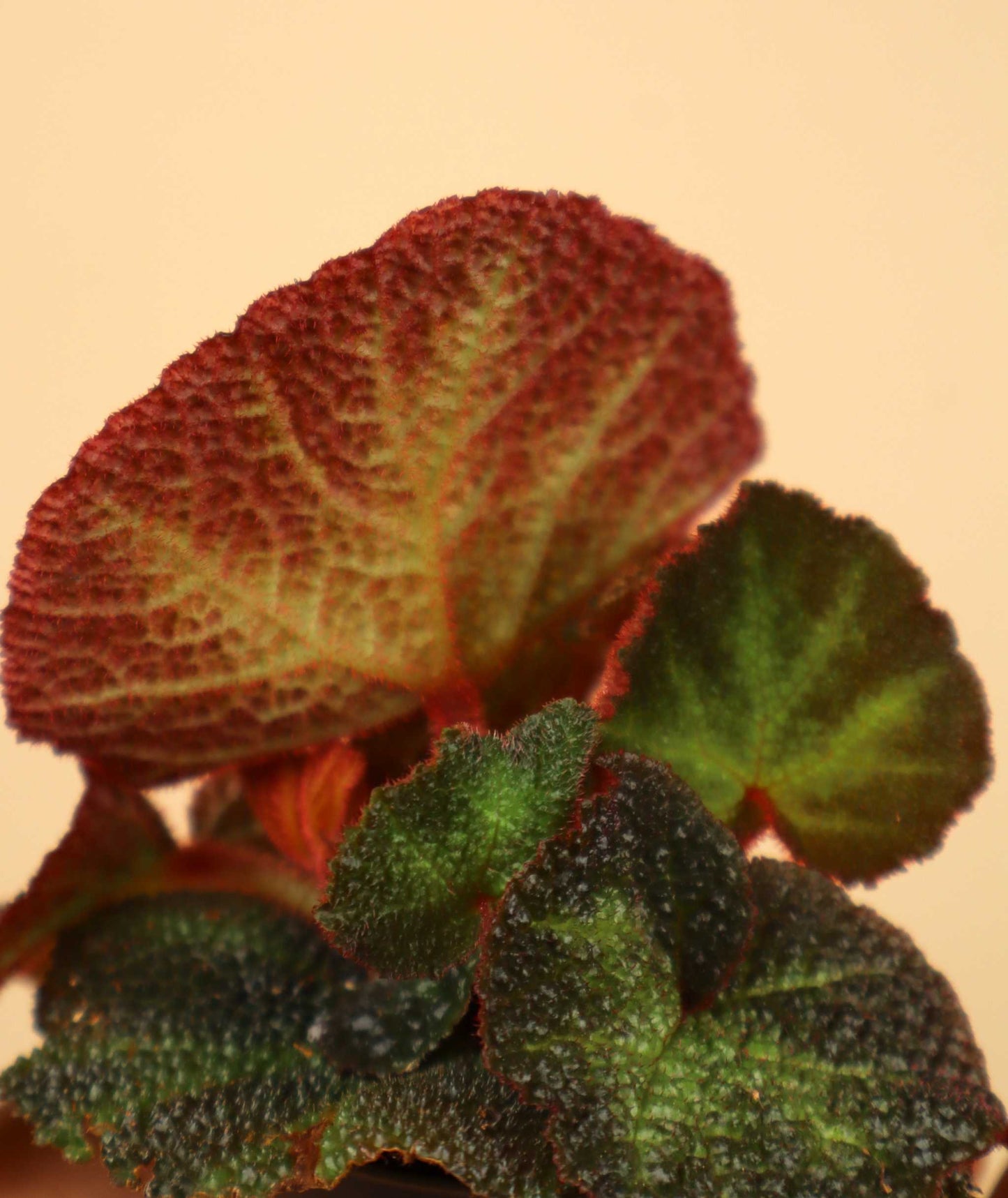
Begonia solimutata originates from Brazil, more precisely from the area around the city of Itaperuna in the state of Rio de Janeiro. There, it is warm year-round and at least intermittently very dry. This begonia has some adaptations to this drought: its leaves are thickened and hairy, which protects them from evaporation, and their flat, low-lying growth habit with the leaves pressed against the ground helps to retain moisture beneath the leaves.

The base color of the leaves is an unsaturated dark green that appears black in the right light. The main veins are highlighted in light green. The leaf surface is covered with numerous small bullae (bumps) that bear reddish hairs. The undersides of the leaves are light green and red and even more hairy. The leaves grow to about 18 centimeters long and 10 to 12 centimeters wide and are held horizontally just above the ground, making them like a mini-greenhouse where condensation can collect underneath them in nature.
Begonia solimutata has a creeping growth habit. The flowers are borne on flower stalks up to 30 centimeters high and are about 1 centimeter in size and white. Without inflorescences, it only grows about 5 to 10 centimeters high if you allow it to spread its leaves.
Care
Thrives in partial shade with good ventilation and warm temperatures. Grows best in very loose and airy substrate such as long-fiber sphagnum moss or coco chips. Likes consistently slightly moist soil but not wet, and can also dry out for a short period. In a terrarium, care should be taken so that the leaves do not remain wet for a long time.
It is easier to grow as a houseplant than in a terrarium. Protect from direct sun and excessively dry air, otherwise, it will develop unsightly brown leaf edges.
Must be fertilized regularly, otherwise, it often sheds most of its leaves. Apply mild complete fertilizer at half concentration approximately every two weeks. A potassium-rich fertilizer (for example, for cacti) produces stronger stems and more robust leaves. Buy Begonia solimutata online!
Shipping Policy
Shipping Policy
When buying live plants, transport can sometimes affect the condition of the plant. We strive to ensure that all plants arrive in good health, but minor shipping damage, such as a torn leaf or bent stem, is sometimes unavoidable. Read more about our policy here.



Join the customer club
Earn points on purchases and through special actions. Spend your points on rewards including gift products & discounts
Learn more about your plants!
View all-

How to repot houseplants - Step by step
Repotting houseplants is the key to keeping your indoor plants healthy and happy. It's all about the right soil, the right size pot and a little patience. In our guide...
How to repot houseplants - Step by step
Repotting houseplants is the key to keeping your indoor plants healthy and happy. It's all about the right soil, the right size pot and a little patience. In our guide...
-
Indoor Climbing Plants | Complete Guide to Clim...
Indoor climbing plants bring life and movement to your home. They can hang freely from hanging baskets or climb up trellises. These green plants quickly transform windows and corners into...
Indoor Climbing Plants | Complete Guide to Clim...
Indoor climbing plants bring life and movement to your home. They can hang freely from hanging baskets or climb up trellises. These green plants quickly transform windows and corners into...
-

Propagate your Houseplants | Tips from the Expert
Is there anything more satisfying than watching a new plant grow from a cutting you made yourself? Plant propagation involves creating new plants from parts of your existing plants. It's...
Propagate your Houseplants | Tips from the Expert
Is there anything more satisfying than watching a new plant grow from a cutting you made yourself? Plant propagation involves creating new plants from parts of your existing plants. It's...

