


Tillandsia juncea
Tillandsia juncea
Couldn't load pickup availability


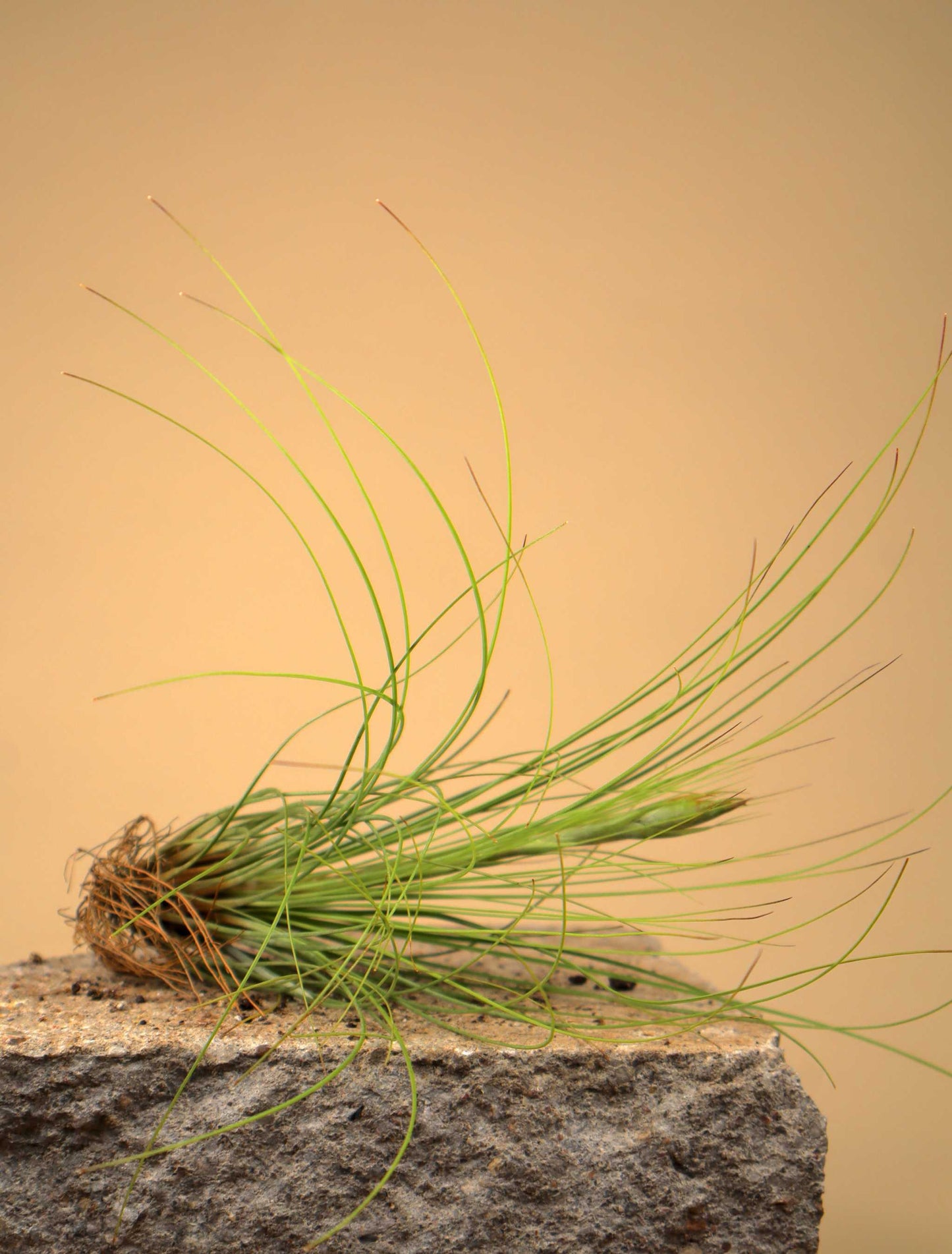
Grass-like air plant with thin upright leaves forming dense clumps
Tillandsia juncea is an epiphytic air plant with a wide distribution, from southern Mexico through Central America (Guatemala, El Salvador, Costa Rica) and on to Colombia, Venezuela, Peru, and Brazil.
The plant has very thin but surprisingly tough leaves that mainly grow straight upwards, giving it a grass-like appearance. This is also reflected in the species name, as Juncus means rush or sedge in Latin. The leaves measure 15 to 25 centimeters and the plant reaches a diameter of approximately 5 centimeters and a length of up to 30 centimeters.
Over time, it forms large, very dense clumps of several dozen individual plants, making it an impressive sight in a collection. The flowers are purple and about 3 centimeters wide, borne on long, reddish flower stalks with reddish bracts.
Care
Thrives in bright, indirect light with good air circulation. Water by spraying or dipping the plant a few times a week, and always allow it to dry out thoroughly between waterings.
Since the leaves are tightly packed at the base, it is especially important that the plant dries completely after watering; ideally, turn it upside down for a while so that no water remains between the leaves. Ideal temperature 18-28 degrees Celsius.
It is best mounted on bark, cork, or wood where it can form its dense clumps over time.
Shipping Policy
Shipping Policy
When buying live plants, transport can sometimes affect the condition of the plant. We strive to ensure that all plants arrive in good health, but minor shipping damage, such as a torn leaf or bent stem, is sometimes unavoidable. Read more about our policy here.



Join the customer club
Earn points on purchases and through special actions. Spend your points on rewards including gift products & discounts
Learn more about your plants!
View all-

How to repot houseplants - Step by step
Repotting houseplants is the key to keeping your indoor plants healthy and happy. It's all about the right soil, the right size pot and a little patience. In our guide...
How to repot houseplants - Step by step
Repotting houseplants is the key to keeping your indoor plants healthy and happy. It's all about the right soil, the right size pot and a little patience. In our guide...
-
Indoor Climbing Plants | Complete Guide to Clim...
Indoor climbing plants bring life and movement to your home. They can hang freely from hanging baskets or climb up trellises. These green plants quickly transform windows and corners into...
Indoor Climbing Plants | Complete Guide to Clim...
Indoor climbing plants bring life and movement to your home. They can hang freely from hanging baskets or climb up trellises. These green plants quickly transform windows and corners into...
-

Propagate your Houseplants | Tips from the Expert
Is there anything more satisfying than watching a new plant grow from a cutting you made yourself? Plant propagation involves creating new plants from parts of your existing plants. It's...
Propagate your Houseplants | Tips from the Expert
Is there anything more satisfying than watching a new plant grow from a cutting you made yourself? Plant propagation involves creating new plants from parts of your existing plants. It's...

