

Philodendron heterocraspedon
Philodendron heterocraspedon
Couldn't load pickup availability
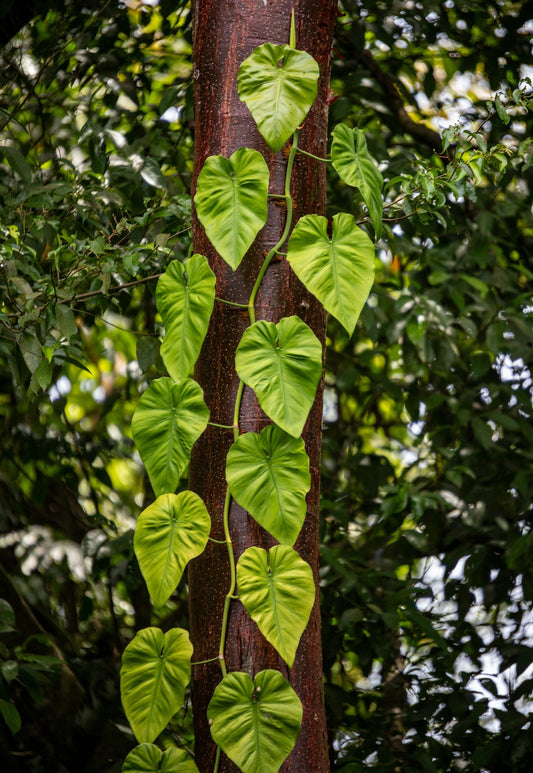
A species from Colombia with long, pendulous leaves with sunken nerves
This is one of the most beautiful of all Philodendrons according to many enthusiasts. The leaves grow to a full 80 centimeters long but only about 10-15 centimeters wide and hang downwards, especially on larger, climbing plants. They are semi-glossy dark green and have sunken leaf veins on the sides.
The midrib is prominent and brightly colored. They resemble the leaves of Philodendron patriciae or Anthurium veitchii.
The leaves are borne on very long petioles, spread widely, and in mature plants form a sort of crown near the top while the trunk remains fairly bare. In the wild it grows up to 2.5 metres tall.
Botanical description
Philodendron heterocraspedon is native to the area around Buenaventura, a city in the Colombian department of Valle del Cauca, in the southwest of the country. Based on field notes by aroid botanist Dr. Thomas B. Croat, it grows both as an appressed epiphyte (growing close to the host tree) and as a terrestrial species (in the ground).

Typically for Philodendron, it is a hemiepiphyte, meaning it starts growing on the ground and then climbs a nearby tree. The species has also been observed growing on steep banks and as a hemiepiphytic liana.
The leaf blades are almost leathery to the touch and either semi-glossy or slightly matte on the upper surface but considerably paler underneath. The primary lateral (sideways) nerves are slightly depressed on the upper surface and raised underneath.
The petioles are sharply C-shaped (sometimes almost D-shaped) when viewed in cross-section.
Care
Philodendron heterocraspedon first grows along the ground until it finds something to climb on. At this stage of its life it is small and can handle very little light. Once it has found a tree it grows up the tree and clings to it with aerial roots. At that point it needs more light.
The plant therefore likes a lot of light but not full midday sun. It prefers a location with bright but indirect light, for example placed directly by a west/east window or placed slightly to the side by a south window. A little direct morning sun or in the winter a little more direct sun will not hurt.
This species will only form its adult leaves if it has both enough light and a support to climb on. As a houseplant, the best support is a moss stake.
The temperature should not be below 18°C at night and at least 20°C during the day. Avoid temperatures above 28°C for extended periods.
The soil and moss pile should never dry out completely, but it definitely shouldn't be really wet for a long time. It's better to water a little less and let at least the surface dry out in between.
Fertilize from May to September. Use a regular potted plant food. For young plants that are not yet climbing, fertilize less (halve the manufacturer's instructions).
Plant in a highly porous, acidic, nutrient-poor mixture that mimics rainforest soil. Use a special substrate made of bark chips, sphagnum moss, and perlite as our soil mix.
Shipping Policy
Shipping Policy
When buying live plants, transport can sometimes affect the condition of the plant. We strive to ensure that all plants arrive in good health, but minor shipping damage, such as a torn leaf or bent stem, is sometimes unavoidable. Read more about our policy here.


Join the customer club
Earn points on purchases and through special actions. Spend your points on rewards including gift products & discounts
Learn more about your plants!
View all-

How to repot houseplants - Step by step
Repotting houseplants is the key to keeping your indoor plants healthy and happy. It's all about the right soil, the right size pot and a little patience. In our guide...
How to repot houseplants - Step by step
Repotting houseplants is the key to keeping your indoor plants healthy and happy. It's all about the right soil, the right size pot and a little patience. In our guide...
-
Indoor Climbing Plants | Complete Guide to Clim...
Indoor climbing plants bring life and movement to your home. They can hang freely from hanging baskets or climb up trellises. These green plants quickly transform windows and corners into...
Indoor Climbing Plants | Complete Guide to Clim...
Indoor climbing plants bring life and movement to your home. They can hang freely from hanging baskets or climb up trellises. These green plants quickly transform windows and corners into...
-

Propagate your Houseplants | Tips from the Expert
Is there anything more satisfying than watching a new plant grow from a cutting you made yourself? Plant propagation involves creating new plants from parts of your existing plants. It's...
Propagate your Houseplants | Tips from the Expert
Is there anything more satisfying than watching a new plant grow from a cutting you made yourself? Plant propagation involves creating new plants from parts of your existing plants. It's...

