


Begonia listada
Begonia listada
Couldn't load pickup availability


![]()
![]()
![]()
![]() Begonia listada is an easy-care species that is suitable as a potted plant and in the terrarium.
Begonia listada is an easy-care species that is suitable as a potted plant and in the terrarium.
This Brazilian species is so distinctive that it has its own garden group: the shrub-like listada-type begonias with distinctive leaf pattern.
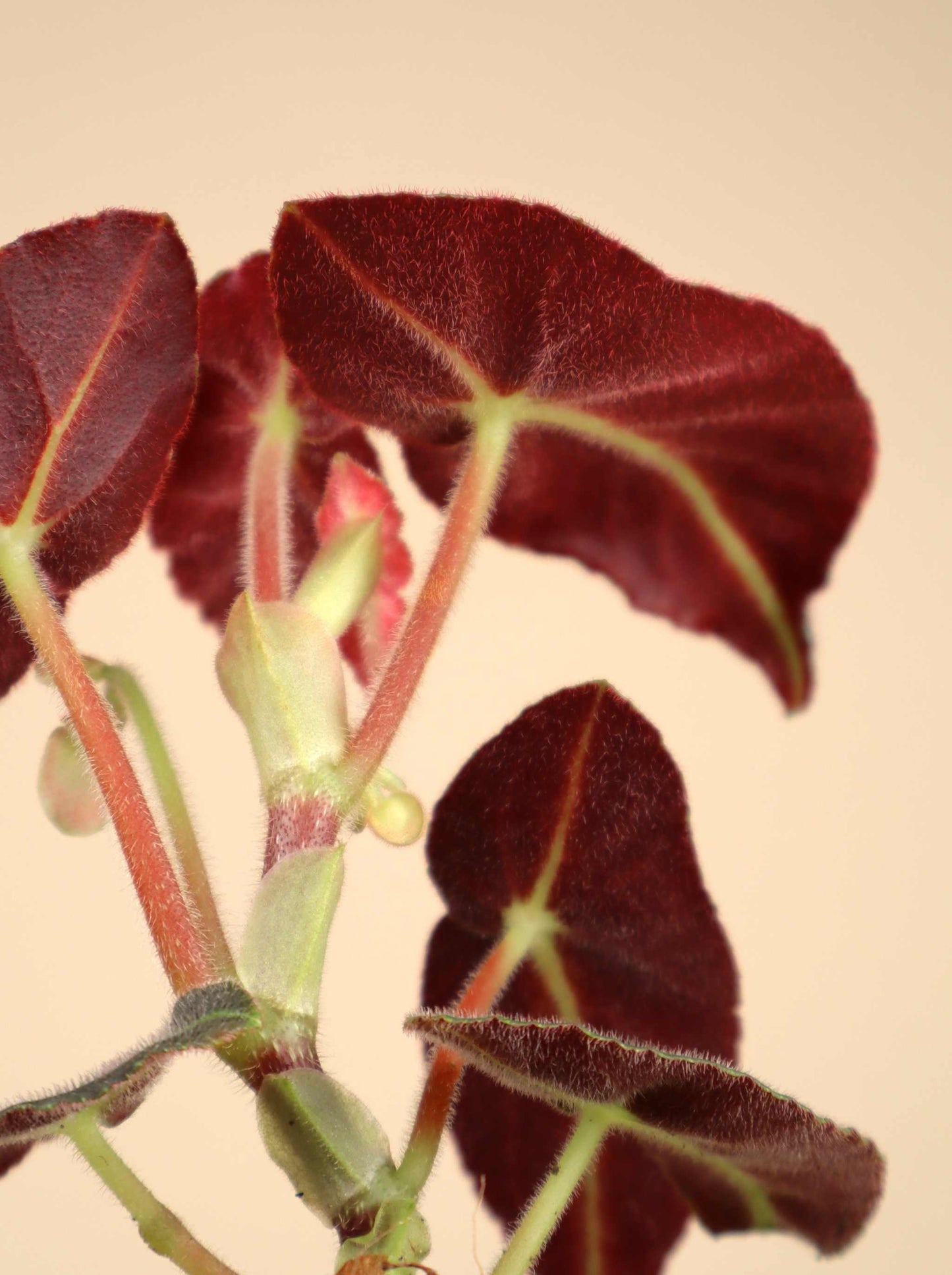
The species has an elliptical leaf blade that comes to a point at each end. It is covered with thick hairs that give it an incredible texture. The leaf surface is dark green with a white line down the middle. The back of the leaves is red. An average leaf measures 10 centimeters long and 2.5-4.5 centimeters wide. Sometimes the species can spontaneously mutate and produce arrowhead-like or triangular leaves on a stem, but this is not a stable mutation.
The growth habit is somewhat horizontal. It can become a beautiful hanging plant or be given plant support to grow upright. The sparse white flowers appear mostly in autumn and winter, and in bright light the buds are covered in pink hairs.
Botanical description
Begonia listada was determined to be a rare species that grows in Rio Grande do Sul, a state located at the southern tip of Brazil near Paraguay and Uruguay.

For many years the plant was labeled as B. listada hort. (hort. stands for horticulture and means that this is a garden name, not an official botanical Latin name).
When it was determined that this was an undescribed species and therefore had no official botanical name, Thelma O'Reilly of La Mesa, California, provided the Smithsonian Institution with a type specimen. From this plant, Dr. Lyman Smith and Dr. Dieter Wasshausen wrote a Latin description and legalized the name B. listada in July 1981. Begonia. Listada is spelled "...ta..." and means "striped".
The plant does not grow on limestone in nature, so calcareous substrates should be avoided. In its natural habitat, it grows in the southern tip of Brazil in humid, shady environments.
Care
Place in a location with partial shade and warm temperatures. B. listada likes bright light, but not intense direct sunlight. Strong sun can cause the leaves to curl or turn brown at the edges.
The plant thrives best in a loose and airy substrate. Long-fibered sphagnum moss with about 30-40% perlite is good. Do not use calcareous substrate as the species does not grow on limestone in nature.
Keep the humidity at least 60% or more permanently. If you can provide these conditions at home, it can be well cared for as a houseplant. In the terrarium, make sure that water droplets on the leaves dry quickly and that there is sufficient air circulation.
Keep slightly moist at all times, but be careful not to keep it too wet. It should never dry out completely. Fertilize about every other week with a mild plant nutrient at half the recommended concentration.
The species is very easy to propagate by stem or leaf cuttings. From a single leaf it quickly creates a compact, bushy plant.
Shipping Policy
Shipping Policy
When buying live plants, transport can sometimes affect the condition of the plant. We strive to ensure that all plants arrive in good health, but minor shipping damage, such as a torn leaf or bent stem, is sometimes unavoidable. Read more about our policy here.



Join the customer club
Earn points on purchases and through special actions. Spend your points on rewards including gift products & discounts
Learn more about your plants!
View all-

How to repot houseplants - Step by step
Repotting houseplants is the key to keeping your indoor plants healthy and happy. It's all about the right soil, the right size pot and a little patience. In our guide...
How to repot houseplants - Step by step
Repotting houseplants is the key to keeping your indoor plants healthy and happy. It's all about the right soil, the right size pot and a little patience. In our guide...
-
Indoor Climbing Plants | Complete Guide to Clim...
Indoor climbing plants bring life and movement to your home. They can hang freely from hanging baskets or climb up trellises. These green plants quickly transform windows and corners into...
Indoor Climbing Plants | Complete Guide to Clim...
Indoor climbing plants bring life and movement to your home. They can hang freely from hanging baskets or climb up trellises. These green plants quickly transform windows and corners into...
-

Propagate your Houseplants | Tips from the Expert
Is there anything more satisfying than watching a new plant grow from a cutting you made yourself? Plant propagation involves creating new plants from parts of your existing plants. It's...
Propagate your Houseplants | Tips from the Expert
Is there anything more satisfying than watching a new plant grow from a cutting you made yourself? Plant propagation involves creating new plants from parts of your existing plants. It's...

