


Philodendron goeldii
Philodendron goeldii
Couldn't load pickup availability


Taxonomically difficult to define, gigantic aroid from the Amazon with finger-shaped leaves
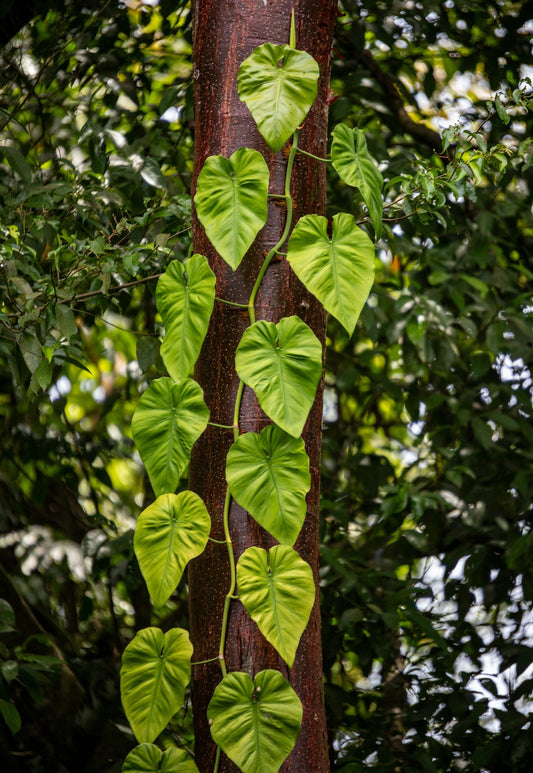
Philodendron goeldii , synonym ' Thaumatophyllum spruceanum ', is a neotropical hemiepiphytic or climbing plant known for its unusually clustered & divided leaves.
P. goeldii is self-supporting and occurs both as a shrub in sandy soil along riverbeds and forest edges, and as a hemiepiphyte (starts growing on the ground and then climbs up) on top of larger trees in dense forest. Its fruit is edible and sweet, reminiscent of pineapple or banana.
Botanical description
The species was first described by Heinrich Wilhelm Schott in 1859 as Thaumatophyllum spruceanum. It was originally the only species in the genus Thaumatophyllum. The specific epithet spruceanum refers to the botanist Richard Spruce, who is credited with first collecting specimens of the plant from the Amazon rainforest in 1851.
The species was later moved to Philodendron in 1962 by Graziela M. Barroso, placed with other members of what was then the subgenus Meconostigma. Molecular phylogenetic research in 2018 resulted in the subsequent resurrection of Thaumatophyllum, with Meconostigma species placed within it. However, the accepted genus for the species is still Philodendron.
Philodendron goeldii is native to the humid rainforests of northern Brazil, Colombia, Ecuador, French Guiana, Peru, Suriname and Venezuela. It grows as a terrestrial (in the ground) with very shortened internodes or climbing and hemiepiphytic with longer internodes, in permanently flooded or seasonally flooded forest and in closed secondary forest along roadsides, common in riverbeds both as a terrestrial and epiphytic plant.
The petioles are very long (45 centimeters or more), round, thickened at the base, short-sheathed and end in a distinct joint (geniculum).
Each leaf consists of 10-20 leaflets, with the central leaflet 18-50 centimeters long. All segments are well separated and connected only by very narrow tissue bridges, giving the leaves a hand-like appearance.
Care
Philodendron goeldii is self-supporting and can be grown as a shrub or climber. It is very easy to care for and forgiving when grown as a houseplant indoors as long as a few simple tips are followed.
Place it in bright, indirect light to partial shade. In the wild, it grows both in dense forests and along riverbeds where light conditions vary. Avoid direct sunlight which can damage the delicate leaves.
Keep the soil evenly moist. The plant thrives in moist environments and can tolerate periodic flooding as in its natural habitat. However, good drainage is important to prevent root rot when grown in a container.
Use a nutrient-rich, well-drained soil mix. A mixture of perlite, orchid bark and coconut fiber works well. The plant thrives in acidic to neutral soil. We recommend our aroid soil.
Fertilize regularly during the growing season with a balanced liquid fertilizer.
Either give the plant a climbing support if you want the hemiepiphytic form, or let it grow as a self-supporting shrub. Both growth patterns are natural for the species. Buy Philodendron goeldii 'fun bun' online
Shipping Policy
Shipping Policy
When buying live plants, transport can sometimes affect the condition of the plant. We strive to ensure that all plants arrive in good health, but minor shipping damage, such as a torn leaf or bent stem, is sometimes unavoidable. Read more about our policy here.


Join the customer club
Earn points on purchases and through special actions. Spend your points on rewards including gift products & discounts
Learn more about your plants!
View all-

How to repot houseplants - Step by step
Repotting houseplants is the key to keeping your indoor plants healthy and happy. It's all about the right soil, the right size pot and a little patience. In our guide...
How to repot houseplants - Step by step
Repotting houseplants is the key to keeping your indoor plants healthy and happy. It's all about the right soil, the right size pot and a little patience. In our guide...
-
Indoor Climbing Plants | Complete Guide to Clim...
Indoor climbing plants bring life and movement to your home. They can hang freely from hanging baskets or climb up trellises. These green plants quickly transform windows and corners into...
Indoor Climbing Plants | Complete Guide to Clim...
Indoor climbing plants bring life and movement to your home. They can hang freely from hanging baskets or climb up trellises. These green plants quickly transform windows and corners into...
-

Propagate your Houseplants | Tips from the Expert
Is there anything more satisfying than watching a new plant grow from a cutting you made yourself? Plant propagation involves creating new plants from parts of your existing plants. It's...
Propagate your Houseplants | Tips from the Expert
Is there anything more satisfying than watching a new plant grow from a cutting you made yourself? Plant propagation involves creating new plants from parts of your existing plants. It's...

